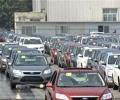
Sales of vehicles across categories registered a growth of 3.75 per cent to 16,19,689 units in January against 15,61,130 units in the same month of 2013
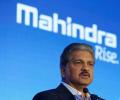
"I took some time to explore the contours of this initiative. I don't use the term 'game-changer' too often but it's apt in this case. For me, what's much more important than the mechanics of the scheme is the dramatic shift it signals in the attitude towards industry," Mahindra said in a tweet.

Indian automakers dispatched nearly 2.92 lakh passenger vehicles, the highest ever for February so far, driven by strong demand for cars and utility vehicles, industry body SIAM said on Friday. The total passenger vehicle dispatches from companies to dealers last month increased 11 per cent to 2,91,928 units from 2,62,984 units in February 2022. Passenger car sales rose to 1,42,201 units in February against 1,33,572 units in the year-ago period.

"These latest so-called 'Liberation Day' tariffs are reckless and self-destructive, inflicting financial pain on Illinois at a time when people are already struggling to keep their small businesses afloat and put food on the table."

The move to implement a proposal of star ratings on passenger vehicles, similar to those seen on electrical appliances, is likely to be delayed by several months. Stakeholders from the automobile sector and the government are divided over key facets.

http://im.rediff.com/money/2023/jul/20uv.jpg
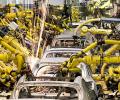
The passenger vehicle dispatches to dealers increased by 11 per cent in July as improvement in semiconductor supplies helped the companies to ramp up production ahead of the festive season, auto dealers' body SIAM said on Friday. Overall passenger vehicle wholesales increased to 293,865 units last month compared to 264,442 units in July 2021. Passenger car dispatches rose 10 per cent to 143,522 units in July from 130,080 units in the year-ago period.

Total sales of commercial vehicles were down by 5.59 per cent to 48,473 units from 51,344 units in the year-ago period, SIAM said.

Sales of commercial vehicles were up 5.63 per cent to 56,032 units in June, SIAM said.

NITI Aayog has not said what the reasons were for having achieved or not having achieved what was sought to be achieved, or what lessons can be learned for the future, points out Aakar Patel.

The RBI on Thursday lowered the benchmark repurchase rate to 7.75 per cent from 8 per cent, the first reduction since May 2013.

The company will also check the reorienting wiring harness related to the correct deployment of side airbags in the recalled vehicles.

Toyota had announced a global recall of 65 lakh vehicles to rectify a power window glitch, which could lead to fire risk.

New participants included Chinese players such as Great Wall Motors and Haima Automobile along with Olectra.

Chinese players form a major part, around 20 per cent of the auto expo this year, despite a slowdown in the Indian automobile sector in the last one year. Over two dozen top officials from various companies were planning to participate in the event, besides a group of journalists.

The next edition of the country's leading automobile show, the Auto Expo, will be held from January 13-18 next year, having been cancelled this year due to the COVID-19 pandemic. The last edition of the biennial automobile show took place in February 2020 amid fears of the spread of the coronavirus across the world. It was supposed to take place in February this year at Greater Noida but was postponed due to the worsening COVID-19 situation.

The impact of Trump's announcement of increasing import tariffs will have negligible benefit for India not because of companies trying to shift from China to other countries or their supply chains being affected due to their Chinese operations but because of our faulty policies, explains Mudit Jain.

Amid better semiconductor chip supplies, the Indian automotive industry posted an 8 percent growth in production of vehicles across categories for the month of May, with three-wheelers (20 per cent) and passenger vehicles (16 per cent) leading the pack. Exports, however, dipped 21 per cent at an industry level. The industry also recorded its highest-ever May wholesales of domestic passenger vehicles (334,802 units), riding on high demand for sport utility vehicles (SUVs) and better supplies of semiconductor chips.

The automobile sector has started seeing volume growth, the crucial economy segment included. Maruti Suzuki India (MSIL) could be a big beneficiary as the country's largest passenger vehicle (PV) maker has seen several favourable developments including volume recovery. Demand for its new sports utility vehicles (SUVs) appears to be good, and the company has 4 lakh outstanding orders by April 2023, (up from 3.6 lakhs in January 2023). Siam (Society of Indian Automobile Manufacturers) estimates that passenger vehicle demand would grow by 5-7 per cent in the 2023-24 financial year (FY24) and MSIL is likely to beat the market growth.

An average of 30-40 per cent automation is standard across all big automobile plants in the country

Domestic passenger vehicle sales dropped by 17.54 per cent to 2.25 lakh units in June from 2.73 lakh units in the same month of previous year, data released on Wednesday by an apex industry body showed.

The muted expectation of dealers come at a time when vehicle manufacturers such as Maruti Suzuki, Hyundai Motor, Mahindra & Mahindra and others reported a double-digit fall in wholesale dispatches to dealerships in July and August.

Maruti Suzuki India Limited (MSIL), the country's largest car maker, has initiated a service campaign to inspect a probable fault and replace a part of the clutch operation system in the Ciaz, its mid-size sedan.
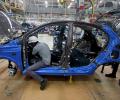
Automobile industry in India is going through a long-term structural slowdown as the compound annual growth rate (CAGR) across all major vehicle segments has witnessed a decline over the last three decades, as per industry body SIAM. The auto industry has been facing headwinds even before the COVID-19 pandemic derailed the entire sector last year, a research conducted by the Society of Indian Automobile Manufacturers (SIAM) has revealed. The study clearly shows that the pandemic is not the only reason for the auto sector slowdown, which is facing deeper structural issues that need attention, the industry body noted.

As part of the new Central Motor Vehicle Rules, the government is framing a mandatory recall policy entailing penalties.

Passenger vehicle wholesales in India rose significantly year-on-year in July, as COVID-led restrictions eased across states and companies pushed stocks to dealers to build up inventories for the upcoming festive season, SIAM said on Thursday. The total passenger vehicle sales -- including dispatches of cars, utility vehicles and vans -- from OEMs to dealerships increased by 45 per cent to 264,442 units in July against 182,779 units in the same month last year. According to the latest data by the Society of Indian Automobile Manufacturers (SIAM), two-wheeler dispatches from the OEMs to dealerships, however, declined by 2 per cent to 12,53,937 units in July, compared to 12,81,354 units in the year-ago period.

The recall is only for the diesel variants of the three models. Out of the total, 55,938 units are of old Dzire, 12,486 units of old Swift and 1,131 units of Ritz, which were manufactured between March 8, 2010 and August 11, 2013, the company said.

The local arm of the Japanese two-wheeler manufacturer accounts for every second scooter sold in India.

In the 2012-13, car sales in India fell 6.69 per cent, which was the first decline in a decade.

Passenger vehicle exports from India increased 43 per cent in FY22, with Maruti Suzuki India leading the segment with dispatches of over 2.3 lakh units, as per the latest data by industry body SIAM. The total passenger vehicle (PV) exports stood at 5,77,875 units in 2021-22 fiscal, as compared to 4,04,397 units in 2020-21. Passenger car shipments saw 42 per cent growth at 3,74,986 units, while utility vehicle exports rose 46 per cent at 2,01,036 units during the last fiscal, the data by the Society of Indian Automobile Manufacturers (SIAM) showed.

Jimny will be priced between Rs 12.7 lakh and Rs 15.05 lakh.

Even as India overtakes Japan in automotive sales in 2022, moving to third place for the first time, oddly enough the country's biggest motor show is going to see some big hitters give it a clear miss. Some prominent automotive brands have cited high event costs, negligible returns on investment, poor event management, and unfavourable location as reasons for their reluctance to participate. Major pure-play electric two-wheelers, too, are riding past this year's edition of the Auto Expo.

TVS Motor Company, the only company in India to manufacture mopeds, said domestic sales dropped by 25.58% in April-Oct and exports fell by nearly 40%.

Tata Group is in discussions with some major international companies, including those from Taiwan, for its foray into the semiconductor chip business. The Union government had earlier tried to bring in Taiwanese manufacturers Taiwan Semiconductor Manufacturing Company (TSMC) and United Microelectronics Corporation (UMC) for chip manufacturing in India. A person close to the development said the Tatas have now opened a separate channel for a possible tie-up. Currently, India mostly imports chips, which are fabricated and assembled to put into various applications, including automobiles, renewable power, mobile phones, televisions, and other electronic items.

The exercise is in keeping with SIAM's voluntary code on vehicle recall

Passenger vehicle wholesales in India declined nearly 4 per cent to 279,501 units last month, auto industry body SIAM said on Wednesday. Passenger vehicle (PV) dispatches from factories to dealerships in March 2021 stood at 290,939 units. As per the latest data by the Society of Indian Automobile Manufacturers (SIAM), two-wheeler sales also fell 21 per cent to 11,84,210 units as compared with 14,96,806 vehicles in March 2021.

Some of the notable models set to make a debut next year include the Tata Harrier, the Mahindra S201, the Kia SP Concept, MG Motors' Boujun 530, and the Honda HR-V.

The industry is engaged in a dialogue with the Government of India on policy measures which could minimise the impact of COVID-19 on the Indian economy and especially the domestic automobile industry.

Consumer goods firms and auto companies are witnessing an upturn in rural demand, which had been lagging for most of FY24. Expectations of a bumper rabi crop harvest have helped turn the tide. The Reserve Bank of India's (RBI's) Monetary Policy Committee kept the repo rate unchanged last week, noting that as rural demand catches up, consumption is expected to support economic growth in 2024-25.

Higher exports will also drive up volumes, as the company seeks to avail of the benefits under the government's recently announced production linked incentive scheme.
 © 2026 Rediff.com - Advertise with us - Disclaimer - Privacy Policy - Sitemap - Feedback - About us - Terms of use - Grievances